In India, if you’re considering buying a home, you’ve likely heard of terms like Built-Up, Carpet, and Super Area. Do you know the difference between these measurements, what they actually are, and how these areas are calculated? This article provides you with information in simple terms that you’ll always remember.
Table of Contents
Why These Area Terms Matter in Indian Real Estate
- Your flat price is usually quoted per sq ft – if the builder is using super built-up area instead of carpet area, your “real” usable space might be far less than what the brochure shows.
- RERA (Real Estate Regulation and Development Act, 2016) made it compulsory for builders to disclose the carpet area clearly in agreements, to protect buyers from misleading area calculations.
- Banks often look at carpet area and project approvals before sanctioning a home loan.
Suppose you’re buying an apartment in 2025 in cities like Gurgaon, Noida, Mumbai, Bengaluru, Pune, or any Tier-2 city like Chandigarh. In that case, you must understand these three: carpet area, built-up area, and super built-up area.
1. What Is Carpet Area? (RERA Standard)
Under Section 2(k) of the RERA Act, 2016, Carpet area is the area that you use for living in the house. The area which you keep inside the walls, like bedroom, bathroom, hall, and kitchen, is called the carpet area. In simple words, a carpet area is the space inside your flat where you can actually place furniture and walk around.
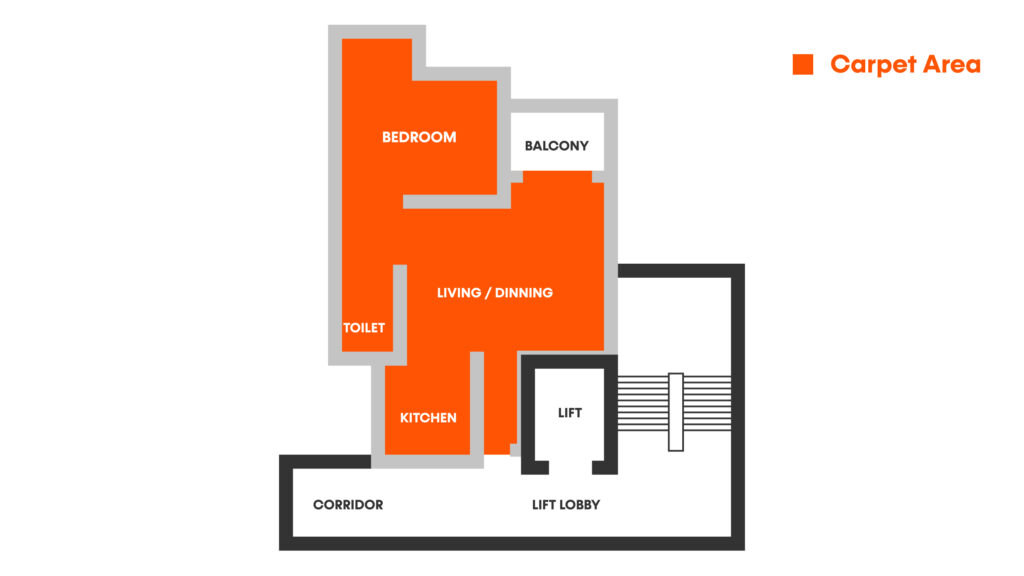
What is included in carpet area?
- Bedrooms
- Living/dining room
- Kitchen
- Bathrooms and toilets
- Internal passage within the flat
- Area covered by internal partition walls
What is not included in carpet area?
Carpet area excludes:
- External walls
- Areas under service shafts
- Exclusive balcony or verandah area
- Exclusive open terrace area
So if you imagine literally spreading a carpet inside all usable spaces of your home (ignoring balconies and open terraces), that’s your carpet area.
RERA Carpet Area vs “Traditional” Carpet Area
Before RERA, many builders casually used “carpet area” to mean different things, often excluding internal walls as well.
Now under RERA:
- RERA Carpet Area includes internal partition walls but excludes balconies, external walls, terrace, and service shafts.
- It is now a legal term and must be clearly mentioned in the Agreement for Sale.
For you as a buyer in 2025, whenever you see “RERA carpet area”, you know it follows a standard, regulated definition.
2. What Is Built-Up Area?
Built-up area is carpet area plus the space occupied by walls and certain additional usable spaces.
Typical definition for Indian apartments
Built-up area = Carpet area + thickness of internal & external walls + balcony + exclusive terrace or utility areas (if any).
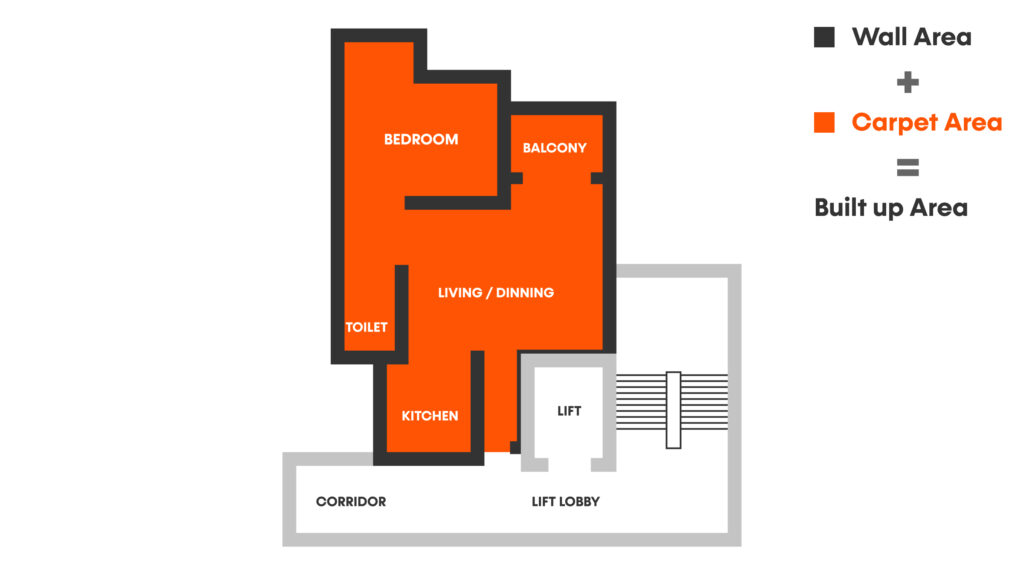
What does built-up area usually include?
- Carpet area (usable indoor space)
- Internal & external wall thickness
- Balconies attached to the flat
- Exclusive utility area / dry balcony
- Sometimes an internal staircase if it’s a duplex unit
In most Indian projects:
- Built-up area is usually 20-30% more than carpet area.
For example, if the carpet area is 800 sq ft, the built-up area might be around 1,000-1,040 sq ft.
3. What Is Super Built-Up Area / Super Area?
Super built-up area (often just called “super area”) is the built-up area plus a proportionate share of common areas.
This is also called the “saleable area”, because many builders still quote the flat price on this figure.
Super built-up area = Built-up area + proportionate share of common areas & amenities
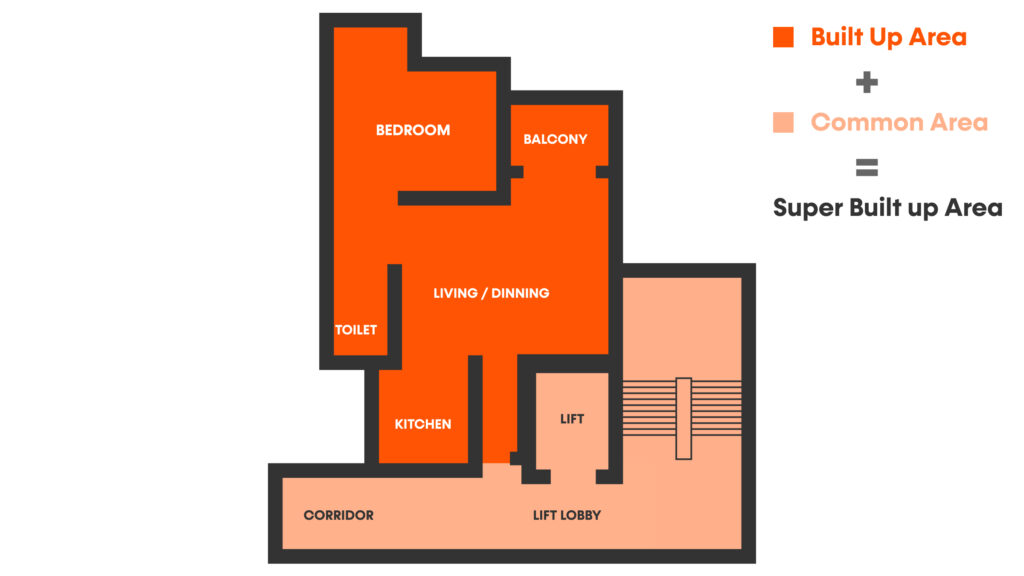
What does super built-up area usually include?
- Entire built-up area of your flat
- Proportionate area of:
- Lobby and corridors
- Lift and lift lobby
- Staircases
- Security room
- Clubhouse, indoor games room, etc. (depending on builder policy)
- Sometimes gym, common terrace, or other indoor amenities
- Compound walls
- Open-to-sky swimming pools
- Open parks, driveways, open sports grounds
Loading Factor – The Hidden Multiplier
The difference between super built-up area and carpet area is often called the loading factor.
Loading factor = (Super built-up area – Carpet area) ÷ Carpet area
Typical range in Indian apartments:
- 25-60% loading is common, depending on project type, amenities, and city.
- Higher the loading, smaller the actual carpet area for the same quoted super area.
4. Carpet vs Built-Up vs Super Area – Quick Comparison
| Parameter | Carpet Area | Built-Up Area | Super Built-Up Area (Super Area) |
| Main idea | Actual usable area inside the flat | Usable area + walls + some exclusive spaces | Built-up area + share of common areas & amenities |
| Includes walls? | Internal partition walls only | Internal + external walls | Yes, part of built-up |
| Includes balcony/terrace? | No | Yes (exclusive balcony/terrace/utility) | Yes |
| Includes lobby, lift, etc.? | No | No | Yes (proportionate share) |
| Typical size relation | Smallest | Medium (≈ 20-30% more than carpet) | Largest (can be 25-60% higher than carpet) |
| Best for comparison | Yes – compare properties on carpet area | Sometimes used | Often used for pricing but can be misleading alone |
5. Real-Life Example: How These Areas Change Your Cost
Let’s say a builder advertises a “2 BHK – 1,200 sq ft” flat in Pune.
When you ask for a detailed breakup, you get:
- Carpet area: 800 sq ft
- Built-up area: 1,000 sq ft
- Super built-up area: 1,200 sq ft
And the price is ₹8,400 per sq ft on super built-up area.
Cost based on super built-up area
- 1,200 × ₹8,400 = ₹1,00,80,000 (≈ ₹1.01 crore)
But what are you effectively paying per sq ft of carpet area?
You are actually paying ₹1,00,80,000 for 800 sq ft of usable carpet area:
- Effective price per sq ft on carpet area
= 1,00,80,000 ÷ 800
≈ ₹12,600 per sq ft (on carpet)
So although the advertisement says ₹8,400/sq ft, for your actual usable area the cost is much higher.
This is why in the modern Indian market, serious buyers, consultants, and RERA-aware developers all focus on carpet area first.
6. What Does RERA Change for Homebuyers?
RERA was introduced precisely because buyers were being misled on area and pricing. Key protections for you:
- Mandatory disclosure of carpet area
Builders must clearly mention the carpet area in all official documents and the Agreement for Sale. - Price must be linked to carpet area in registered documents
While marketing may still show super area, the agreement registered with the authority must be carpet-area based in RERA-compliant projects in most states. - Uniform definition across India
Carpet area definition is no longer arbitrary; it is identical under RERA across all states, with only minor local rules varying. - Legal remedy in case of misrepresentation
If the actual carpet area delivered is significantly less than what was promised, a buyer can raise a complaint with the RERA authority of that state.
For under-construction projects registered under RERA in 2025, carpet area is your anchor. Always read that number first.
7. Practical Tips for Indian Homebuyers in 2025
When you’re shortlisting flats in India, here’s how to use these terms smartly:
- Always ask for all three: Carpet, Built-up, Super built-up
Get the complete area breakup in writing or on email – not just what the sales executive says verbally. - Compare properties only on carpet area
When choosing between two projects, compare carpet area vs total cost. Treat super built-up as a marketing number. - Calculate the loading factor
Use the formula:
Loading factor = (Super built-up area – Carpet area) ÷ Carpet area
- If loading goes above 60%, you’re mostly paying for common areas rather than usable space.
- If loading goes above 60%, you’re mostly paying for common areas rather than usable space.
- Check the floor plan and RERA certificate
- Match carpet area in the brochure with the RERA registration details (available on the state RERA website).
- The floor plan should clearly show room sizes; add them up to verify.
- Understand what you’re paying maintenance for
- Maintenance is often charged on super area or carpet area, depending on society norms.
- If it’s on super area, remember you’re paying for your share of common facilities every month.
- Be extra careful in resale deals
Older projects (pre-RERA) may still only mention built-up or super built-up area. Try to estimate the carpet area yourself by measuring or using the floor plan.
FAQs
Which area should I focus on while buying a flat – carpet, built-up or super?
Focus on carpet area first. That’s the actual usable space where you will live. Built-up and super built-up help you understand how much extra you are paying for walls and common areas, but for day-to-day living and furniture planning, carpet area is what matters most.
Is there any standard percentage difference between carpet and super built-up area?
Can a builder charge me based on super built-up area under RERA?
RERA mainly regulates and standardises carpet area for transparency, and registered agreements must clearly state it. However, builders may still market and present prices on a super built-up basis in advertisements. What matters is:
The Agreement for Sale must clearly state the carpet area and the total consideration based on it as per your state’s RERA rules and practice.
When in doubt, consult a local RERA-registered real estate consultant or lawyer.
Does carpet area include balconies?
How can I verify the carpet area of my flat myself?
Take the floor plan with room dimensions.
Calculate each room’s area (length × breadth) in sq ft or sq m.
Add up the areas of all usable rooms (bedrooms, hall, kitchen, toilets, utility inside, passages).
Compare the total with the RERA carpet area mentioned in your agreement.
You can also hire an independent architect or surveyor if you want professional verification before registration or possession.
Final Takeaway
- Carpet area = where you actually live.
- Built-up area = carpet area + walls + some exclusive spaces.
- Super built-up area (super area) = built-up area + your share of common spaces and amenities.
In the Indian real estate market of 2025, with RERA fully in force across most states, an informed buyer always starts with carpet area, then checks built-up and super area, and finally looks at the effective per sq ft cost on carpet area.